Interview: Kalliopi Mingeirou
State, Tech, and Society Must Unite to End Violence Against Women
Jahangir Sur
প্রকাশ : ১৮ মে ২০২৬ ১৯:০৬ পিএম
আপডেট : ১৮ মে ২০২৬ ১৯:৩২ পিএম
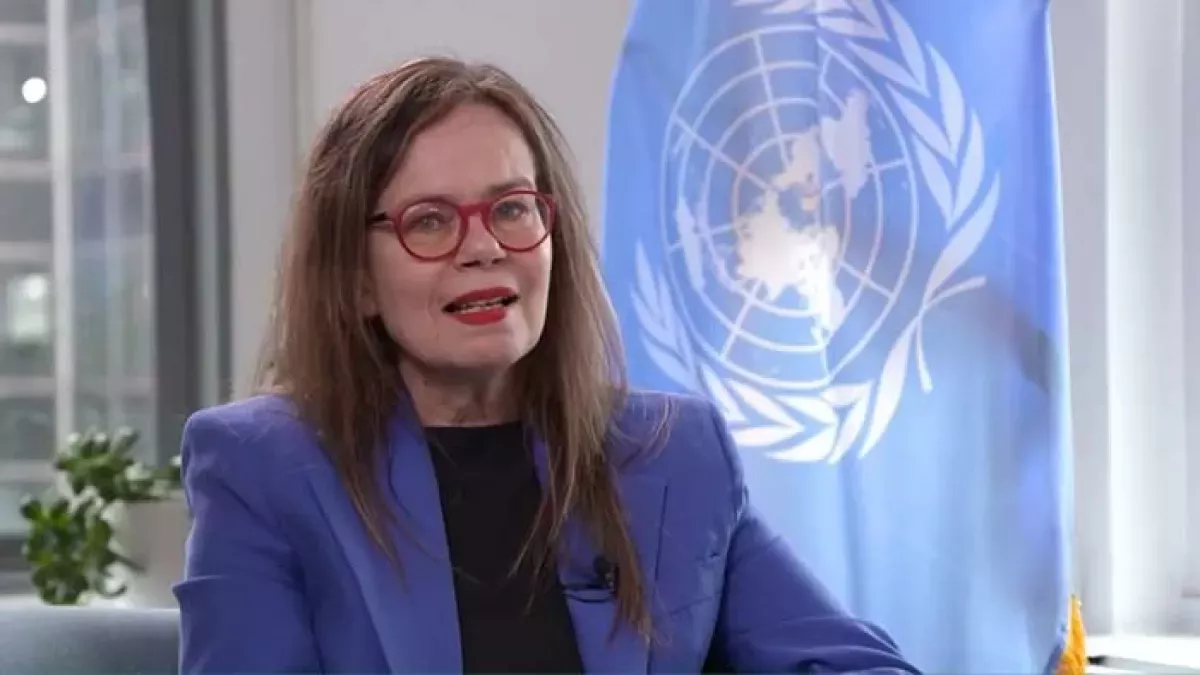
Kalliopi Mingeirou, Chief of the Ending Violence Against Women and Girls, UN Women
Isolated initiatives are no longer enough to stop violence against women, whether online or offline. What is urgently needed is a unified vision bridging the state, technology companies, the media, and civil society. Kalliopi Mingeirou, Chief of the Ending Violence Against Women and Girls Section at the UN Women, elaborated on the actionable steps required to guarantee women’s safety in the digital public sphere and to build highly effective prevention strategies. The interview was conducted via email by Jahangir Sur, the Copy Editor at Protidiner Bangladesh.
Kalliopi Mingeirou: Online attacks on women are not random or opportunistic — they are deliberate and coordinated, designed to silence women’s voices and undermine their participation in public discourse while undermining their professional credibility and personal reputations. As the UN Secretary General’s latest report on VAWGAs the UN Secretary General’s latest report on VAWG highlighted, anti-rights actors are increasingly utilizing online platforms to propagate narratives that challenge gender equality and women's rights, with tactics that include creating a hostile digital environment for women and girls marked by cyberbullying, harassment and threats of violence, and that this phenomenon is deeply intertwined with the escalation of violence against women, particularly through gendered attacks targeting women human rights defenders, women's rights activists and women engaged in public life.
The "manosphere" — a decentralized cross-platform ecosystem of forums, influencers, and online communities united by opposition to feminism — provides both the ideological framework and the organizational infrastructure for these attacks.
Tactics include coordinated dogpiling, doxxing, and gendered disinformation campaigns. What makes platforms "frictionless and rewarding" for perpetrators is their architecture: AI-driven recommendation algorithms actively amplify engagement. Monetization models reward outrage and controversy, turning misogyny into a profitable strategy for” manfluencers”.
Protidiner Bangladesh: The recent report positions these attacks as part of a broader, global pushback against gender equality. What are the underlying social, political, or economic drivers fueling this specific resurgence of misogyny, and why are women in highly visible professions— such as journalism and politics—the primary targets?
Kalliopi Mingeirou: Online violence and misogyny are rooted in the same structural gender inequality and harmful social norms that drives all forms of violence against women. Our forthcoming report developed with Equimundo Center for Masculinities and Social Justice, Engaging Men, Ending Violence identifies three intersecting drivers: rigid gender norms emphasizing male dominance, sexual entitlement and emotional suppression; economic precarity, declining educational outcomes and social exclusion that leave young men vulnerable to extremist online communities offering belonging and validation while promoting hostility toward women; and the digital ecosystem that allows online “manfluencers” to deliberately monetize male anxiety with online spaces offering anonymity coupled with little to no accountability.
We are seeing for the first time a very alarming trend which is that younger men are more conservative on gender equality than older generations, they are increasingly endorsing stereotypical gender roles and expressing hostility toward feminism. For instance, research in the United Kingdom found that 52 per cent of boys and men aged 16 to 29 agreed that feminism has “gone too far,” compared to 35 per cent of men over age 60. Women in public life are primary targets precisely because of their visibility and influence and because their participation threatens the dominance of male power structures. Attacks on journalists, politicians, and activists are designed to deter their participation, silence critical voices, and reassert male dominance in public spaces. As the Secretary-General's report notes, these tactics constitute a form of backlash against gender equality, reinforcing patriarchal power both online and offline.
Protidiner Bangladesh: The statistics on self-censorship and mental health trauma (including PTSD, anxiety, and depression) are alarming. Beyond the devastating personal toll, how does this "vicious circle" of silencing female voices threaten broader democratic discourse, press freedom, and institutional integrity?
Kalliopi Mingeirou: The figures from the Tipping Point series are indeed stark. 41% of women human rights defenders, activists and journalists surveyed said they self-censor on social media to avoid online violence and 19% said they self-censored at work. Among women journalists and media workers, there is evidence that self-censorship has in fact worsened with a 50% increase in women journalists and media workers reporting self-censorship in response to online attacks from 2020 (30%) to 2025 (45%).
The mental health toll is severe: nearly one in four respondents have been treated for anxiety and/or depression linked to online violence, and 13 per cent reported being diagnosed with PTSD. But the threat extends well beyond individual suffering. When women journalists do not publish stories, when women politicians moderate their positions, when human rights defenders withdraw from digital platforms, the public loses access to critical information. When that happens at scale, this is not just a women’s rights issue. It becomes a democratic crisis. If women’s voices are pushed out of our public debates, our societies are less informed, less representative and less free.
Protidiner Bangladesh: We are seeing a terrifying rise in the weaponization of generative AI, such as the mass requests for non-consensual, AI-generated explicit imagery. How does the proliferation of these easily accessible AI tools change the landscape of online violence, and how can regulators keep pace with technology that evolves this quickly?
Kalliopi Mingeirou: AI has fundamentally shifted the threat environment by enabling abuse that is simultaneously more sophisticated, more scalable, and more personally devastating. AI enabled violence — including deepfakes, manipulated sexual imagery and videos and other forms of image-based abuse — is intensifying existing patterns of harassment and constraining women's participation in public life. Close to one in four surveyed women have experienced AI assisted online violence, and 6% have been targeted through deepfake imagery and manipulated images/videos. The UN Secretary General’s latest report on VAWG notes that between 90 and 95 per cent of all online deepfakes are non-consensual pornographic images, with around 90 per cent depicting women.
The problem that regulators are facing today is that technology is moving faster than legislation. Laws and policies are failing to keep pace with technological developments. It Is critical that legislation is tech-neutral to ensure it remains time resistant and applicable despite fast evolving technologies. Laws must be adaptive and principle-based rather than tied to specific tools.
Protidiner Bangladesh: With less than 40% of countries having adequate laws against cyber harassment and cyberstalking, there is a massive legal void. What specific international legal frameworks or treaties is the UN advocating for to ensure that digital abuse is criminalized universally and that perpetrators can be held accountable across borders?
Kalliopi Mingeirou: The obligation of States to enact legislation to address VAWG has been established in international human rights treaties, with recent clarifications that the same rights that people have offline must also be protected online. National legislation on digital violence must be anchored in international law, including international human rights law. Over recent years, global and regional frameworks have moved from implicit recognition of TF VAWG to more direct articulation.
The 2024 UN Cybercrime Treaty establishing non-consensual intimate images and online child sexual abuse or exploitation as internationally recognized cybercrimes is a meaningful step. The Global Digital Compact, the Agreed Conclusions of the sixty-seventh session of CSW on innovation and technological change, and education in the digital age for achieving gender equality and the empowerment of all women and girls and the UN General Assembly Resolution 79/152 on the intensification of efforts to eliminate all forms of violence against women and girls: the digital environment (2024) all establish a global normative framework that requires Member States to take measures to prevent and protect women from violence online and through digital technologies.
UN Women’s model framework for legislation on technology facilitated violence against women and girls calls for a human rights-based and comprehensive approach that explicitly recognizes digital violence as a form of gender-based discrimination and violation of women’s human rights. Legislation should address the full spectrum of online violence and should include provisions for capacity strengthening of law enforcement personnel as well as establishing specific protections mechanisms, assistance and support to enable access to justice, legal aid and remedies including specialized support services. Laws should include provisions for the prompt removal of harmful content, provide digital protection orders to provide safety and support to victim-survivors while holding perpetrators accountable and at the same time we call for legislation that can go much further than responding to online attacks by prioritizing prevention. Prevention measures need to encompass education, digital literacy and community-based social norm change as well as safety by design requirements in the development and deployment of digital technologies.
Protidiner Bangladesh: Call for technology companies to build in safeguards and better reporting tools is increasing. Beyond reactive measures, what fundamental changes in platform governance, algorithm design, or corporate accountability must tech giants adopt to proactively prevent their platforms from being used as apparatuses for suppression?
Kalliopi Mingeirou: UN Women is calling for measures that shift the onus for staying safe online from the individual to the owners off platforms where the abuse takes place. Frameworks should focus on safety by design and include requirements for AI tools to undergo checks to ensure they do not reproduce bias before release, rather than focusing on reporting by victims after damage has already been done. When considering regulation for AI, it is crucial to treat it like any other sector that poses risks to public safety. Just as industries such as food, cars, toys amongst others are regulated to ensure safety for consumers, AI systems and tools should also be subject to similar standards and oversight before they are made publicly accessible. We also call for the ethical and transparent use of algorithms to ensure that they do not amplify harmful or violent content or perpetuate gender bias and stereotypes, and all of this requires greater cooperation between platforms to trace malicious accounts and identify repeat offenders. Finally, there is growing evidence of how online misogyny and digital violence are key drivers of and often a gateway to radicalization and violent extremism. Some governments have already started to recognize online misogyny as a pathway into violent extremism and a security threat. It is critical that risk-assessment frameworks for detecting the activity of extremist groups incorporate indicators to enable the identification of misogynistic networks.
Protidiner Bangladesh: Looking toward the future, mitigating this crisis will require a multi stakeholder approach. What are the most urgent, concrete steps that governments, tech companies, media organizations, and civil society must take collaboratively right now to reverse this trend and build a genuinely safe, equitable digital public square for women?
Kalliopi Mingeirou: Self-regulation is not working so we need stronger legal frameworks, more robust regulation and accountability if we want to reverse the trends we are currently seeing. We need governments to close legal gaps — nearly 1.8 billion women currently lack legal protection against online abuse. Second, we need more effective education and training of law enforcement and judicial actors to support action in cases of technology-facilitated violence against women and girls and cultural change within institutions. Victim-blaming has to stop – we need law enforcement professionals to take these forms of violence very seriously. UN Women is also leading efforts globally to strengthen the capacities of law enforcement to adapt to rapid technological advancement including through guidance for police on addressing technology facilitated violence against women and girls and the High Level Network for Gender Responsive Policing. Strengthening global cooperation is critical given the borderless nature of cyberspace, as online crimes often occur outside the jurisdiction of law enforcement agencies. Such challenges contribute to a climate of impunity even where legislation does exist. Eliminating all forms of violence against women and girls whether it occurs online or offline requires a comprehensive and all of society approach. This means governments working in partnership with civil society and women’s rights organizations and cross-sectoral collaboration from sectors such as media and the technology sector to put in place effective prevention strategies including policies and protocols to prevent and respond to all forms of violence against women and girls including online violence as well as transformative work that seeks to shift societal norms and harmful masculinities that underpin violence against women and girls.
Protidiner Bangladesh: We have closely followed your vital work with UN Women, and your relentless advocacy in exposing how misogynistic networks systematically weaponize digital spaces against women is both courageous and profoundly necessary.
Kalliopi Mingeirou: Thank you very much for your great questions and your interest into our work.